Kozuchi Agent is a phase-driven software-repair agent that pairs a
27B open-weight model (Qwen3.5-27B) with reuse orchestration,
K-candidate trajectory sampling, and an agent-internal selector — no closed-source
verifier and no hidden-test access at selection time. It resolves
74.80% of SWE-bench Verified and transfers to Java
(32.03% on Multi-SWE-bench) without language-specific changes.
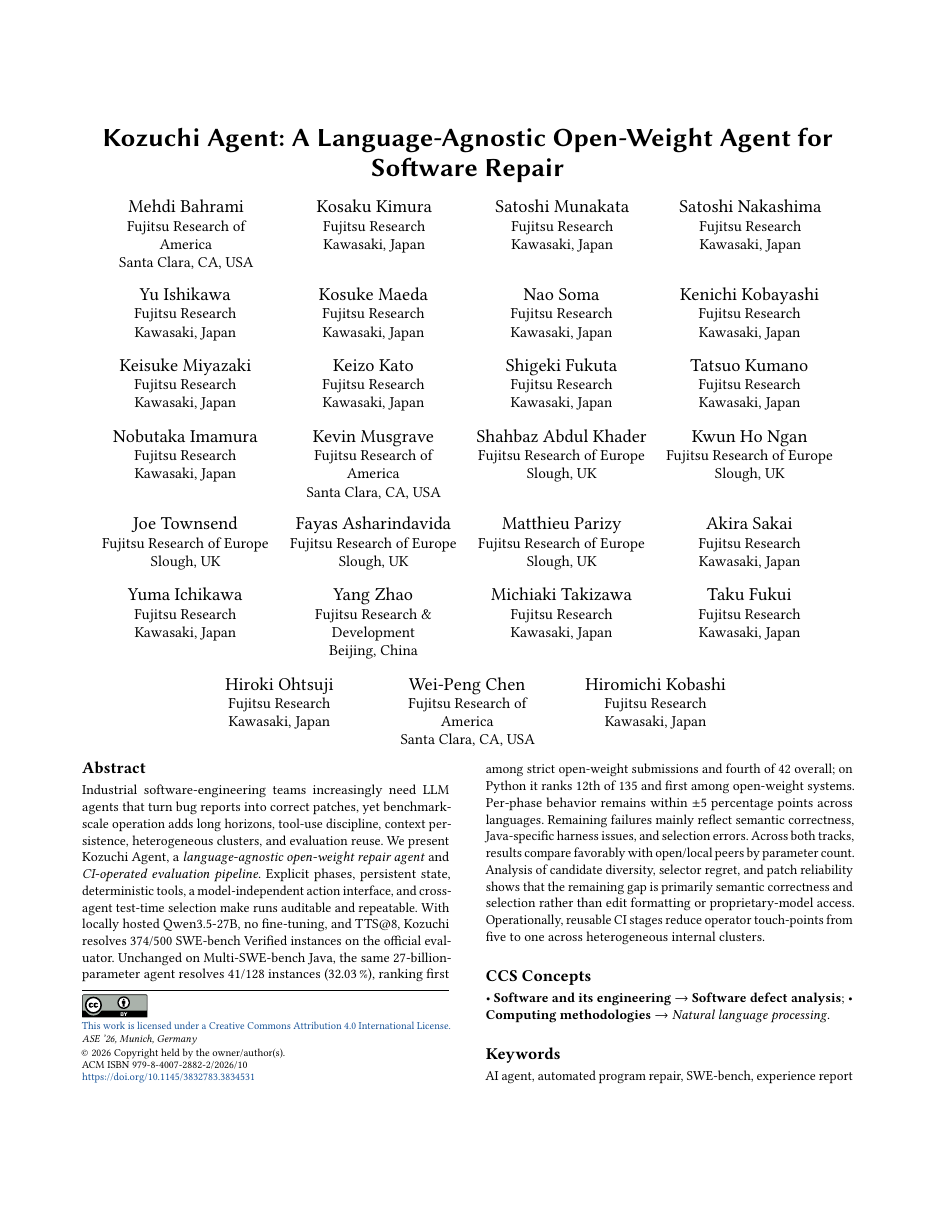
Kozuchi mini-swe-agent + Qwen3.5-27B reaches 74.8% on SWE-bench Verified with
~10–40× fewer parameters than peers at comparable success rates.
— click to open in figures/
Industrial software-engineering teams increasingly prefer LLM agents that turn bug
reports into correct, test-passing patches — but operating such agents at industrial
scale raises harness-level problems: long horizons, tool-use discipline,
context persistence, multi-cluster execution, and evaluation reuse. Kozuchi Agent answers
with a language-agnostic open-weight agent and a
CI-operated evaluation pipeline built on five pillars:
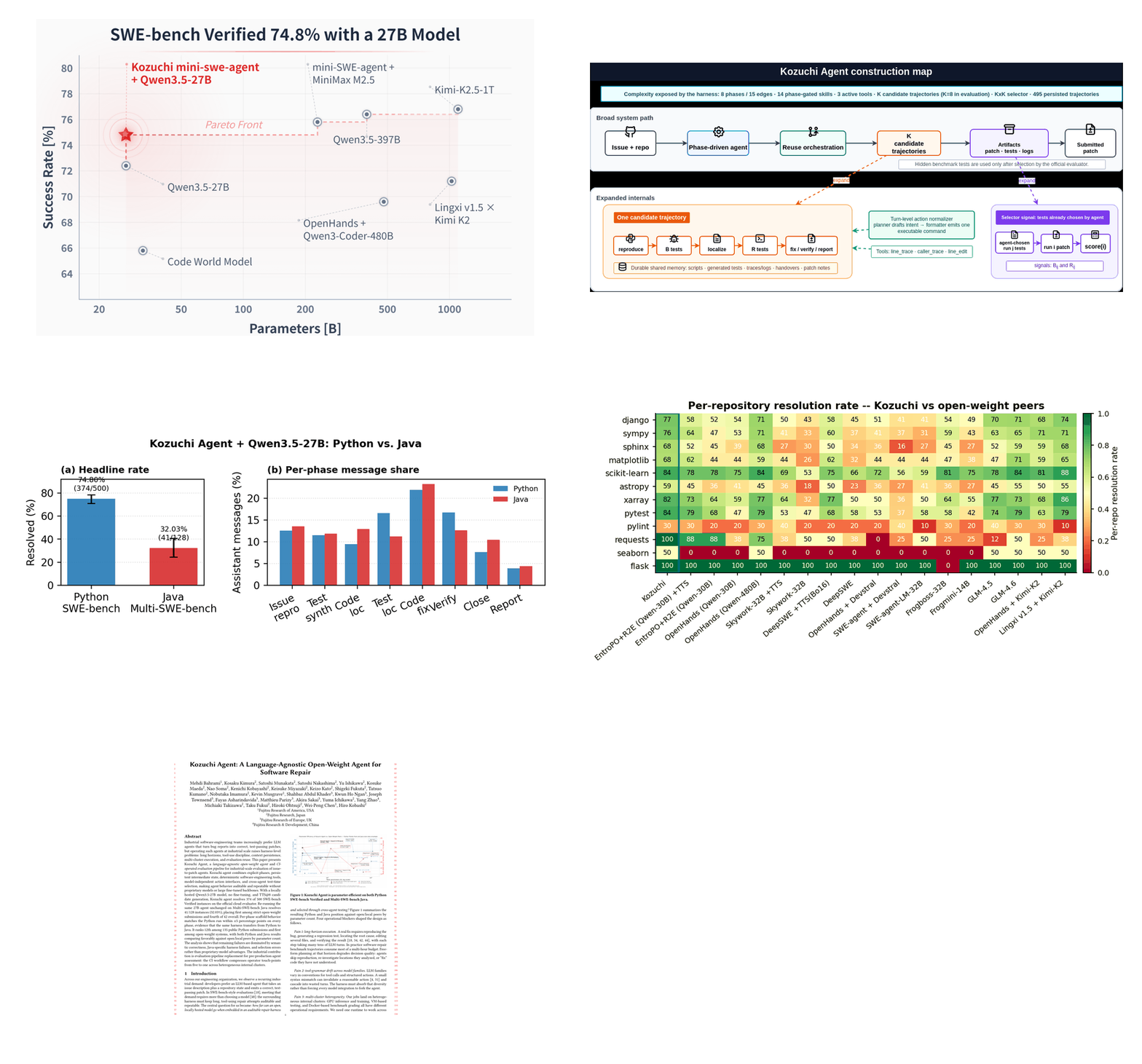
Persistent intermediate stateDurable shared memory — scripts, generated tests, traces, handovers, patch notes — survives across phases and candidates.
Deterministic SE toolsThree active, deterministic software-engineering tools instead of free-form shell improvisation.
Model-independent actionsA turn-level action normalizer keeps the action interface identical across backbone models.
Cross-agent test-time selectionK=8 candidate trajectories per instance, ranked by a K×K selector using only agent-chosen tests — never hidden benchmark tests.
Auditable & repeatableNo proprietary models, no fine-tuning, no large backbones — behavior is reproducible from a locally hosted Qwen3.5-27B.
End-to-end construction map: hidden benchmark tests are used only by the official evaluator, never during selection.
— click to open in figures/
The same harness transfers from Python to Java unchanged: per-phase scaffold behavior
matches the Python run within ±5 percentage points on every phase, and the
remaining failures are dominated by semantic correctness, Java-specific harness failures,
and selection errors — not proprietary-model advantages.
The artifact is self-contained: every numeric value, figure, and table in the paper is
regenerable from files inside the repository, and
INDEX.md
maps each claim to its script, its paper section, and its regenerated output.
$ git clone https://github.com/marscod/kozuchi-agent-artifact
$ cd kozuchi-agent-artifact
$ ./reproduce.sh # every paper number + figure (stats/, figures/, plots/)$ ./reproduce.sh --paper # also rebuild paper/main.pdf$ ./decompress.sh # optional: restore 22 GB of raw trajectories from data/archives/
Requirements: Python 3.10+ (scripts/numbers/ needs no third-party
packages); matplotlib pandas seaborn numpy openpyxl for figures
(auto-handled via uv when available); TeX Live only for
--paper.
🗃Dataset note: the Zenodo record (trajectory datasets for Python and Java) is
under review and not yet publicly published. Until the record goes live, use the
reviewer
preview link and place the downloaded archives under data/archives/.
Mehdi Bahrami, Kosaku Kimura, Satoshi Munakata, Satoshi Nakashima, Yu Ishikawa, Kosuke Maeda, Nao Soma, Kenichi Kobayashi, Keisuke Miyazaki, Keizo Kato, Shigeki Fukuta, Tatsuo Kumano, Nobutaka Imamura, Kevin Musgrave, Shahbaz Abdul Khader, Kwun Ho Ngan, Joe Townsend, Fayas Asharindavida, Matthieu Parizy, Akira Sakai, Yuma Ichikawa, Yang Zhao, Michiaki Takizawa, Taku Fukui, Hiroki Ohtsuji, Wei-Peng Chen, and Hiromichi Kobashi. 2026. Kozuchi Agent: A Language-Agnostic Open-Weight Agent for Software Repair. In Proceedings of the 41st IEEE/ACM International Conference on Automated Software Engineering (ASE '26), October 12–16, 2026, Munich, Germany. ACM, New York, NY, USA, 13 pages. https://doi.org/10.1145/3832783.3834531
BibTeX
@inproceedings{kozuchi2026,
author = {Bahrami, Mehdi and Kimura, Kosaku and Munakata, Satoshi and
Nakashima, Satoshi and Ishikawa, Yu and Maeda, Kosuke and
Soma, Nao and Kobayashi, Kenichi and Miyazaki, Keisuke and
Kato, Keizo and Fukuta, Shigeki and Kumano, Tatsuo and
Imamura, Nobutaka and Musgrave, Kevin and Abdul Khader, Shahbaz and
Ngan, Kwun Ho and Townsend, Joe and Asharindavida, Fayas and
Parizy, Matthieu and Sakai, Akira and Ichikawa, Yuma and
Zhao, Yang and Takizawa, Michiaki and Fukui, Taku and
Ohtsuji, Hiroki and Chen, Wei-Peng and Kobashi, Hiromichi},
title = {Kozuchi Agent: A Language-Agnostic Open-Weight Agent for Software Repair},
year = {2026},
isbn = {979-8-4007-2882-2},
publisher = {Association for Computing Machinery},
address = {New York, NY, USA},
url = {https://doi.org/10.1145/3832783.3834531},
doi = {10.1145/3832783.3834531},
booktitle = {Proceedings of the 41st IEEE/ACM International Conference on
Automated Software Engineering},
numpages = {13},
keywords = {AI agent, automated program repair, SWE-bench, experience report},
location = {Munich, Germany},
series = {ASE '26}
}
08 · One-Minute Tour
The artifact in motion
Headline Pareto frontier, construction map, cross-language transfer, peer heatmap, and the paper itself.